

Lean angle training
If knee dragging, then with brains and the knowledge of what you are doing!
- 3 stations at the same time
- Max. 15 participants
- Max. 5 riders per group
- Maximum riding time – deepen what you have learned
- Lunch, snacks & drinks included
- Very long riding time
Theory – as much as necessary, as little as possible – practice is the motto!
First, we teach all participants the relevant basics and thus create a common knowledge base. The learned content is then directly applied in riding exercises and linked to real practice situations. In this way, the basic knowledge is sustainably consolidated and safely transferred to everyday riding.
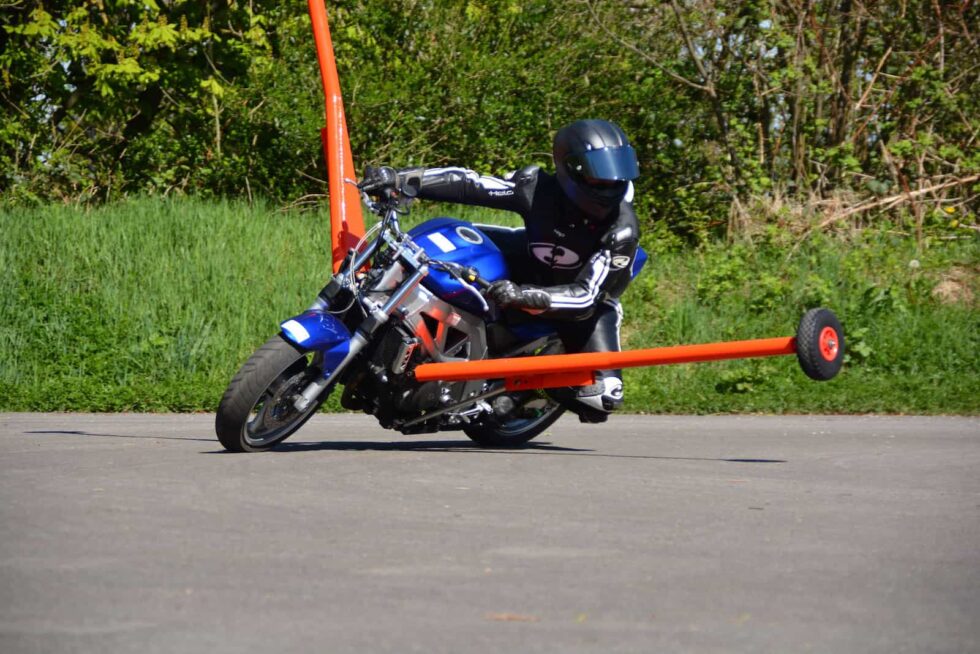
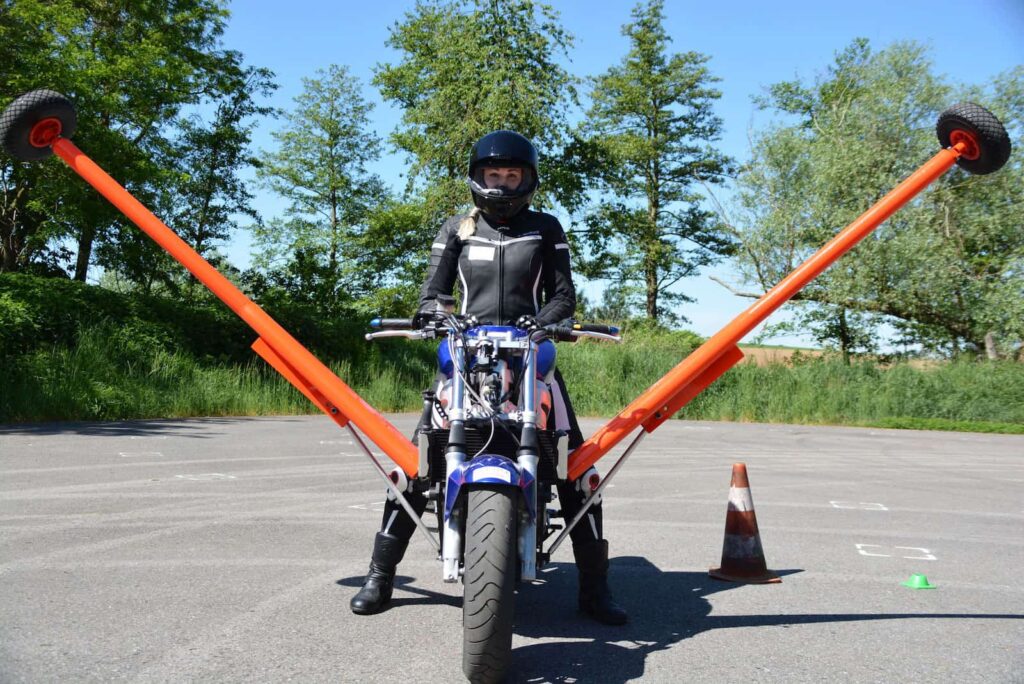
- Entry into practice with the lean angle trainer and special riding exercises.
- Then switching to a pitbike, which makes riding errors visible in a targeted way and allows us to point them out and correct them directly during riding. (Active feedback for maximum learning effect)
- At the theory station, we calmly teach you the body position of hanging off and how the body influences riding dynamics.
Your protective clothing to bring
Please bring your own motorcycle-certified protective clothing. We have NO rental clothes!
Protective clothing
- Textile: jacket and trousers ideally able to be connected to each other
- Leather: one-piece or two-piece
Protectors
- Recommended: back protector
- Mandatory: shoulder, elbow and knee protectors
- Recommended: hip protectors
Gloves
- Certified motorcycle gloves
- Preferably gloves that extend over the wrist
Shoes & helmet
- Certified motorcycle shoes/boots
- Full-face or cross helmet (closed at the chin)
Upcoming lean angle trainings
Our lean angle trainings take place at various locations in Baden-Württemberg. Whether in Asperg, Eppingen, Stuttgart, Heilbronn or at other training locations – here you will find all upcoming dates.
 SchräglagentrainingAvailable
Schräglagentraining Intensiv
 SchräglagentrainingAvailable
Schräglagentraining Intensiv
SchräglagentrainingAvailableSchräglagentraining Intensiv
SchräglagentrainingAvailableSchräglagentraining Intensiv
SchräglagentrainingAvailableSchräglagentraining Intensiv
SchräglagentrainingAvailableSchräglagentraining Intensiv
Racetrck organizes racetrack trainings, pitbike trainings and other events. You can find an overview of all upcoming events on the events page.
Event overviewLean angle training at Racetrck
So that you quickly and clearly get an idea of what a lean angle training at Racetrck looks like, we have put together a video with the help of ChainBrothers.
What you will see in the video
- A real training with a group of students (beginners & advanced)
- Video clips from the first-person perspective
- Students' opinions about the training
- Outtakes
The video will answer 80 % of your questions. You are welcome to ask us your remaining questions personally, by email or by phone at any time.
Why lean angle training and why at Racetrck?
There are many good reasons to complete a lean angle training – the most important one is that many dangerous accidents can be avoided as a result.
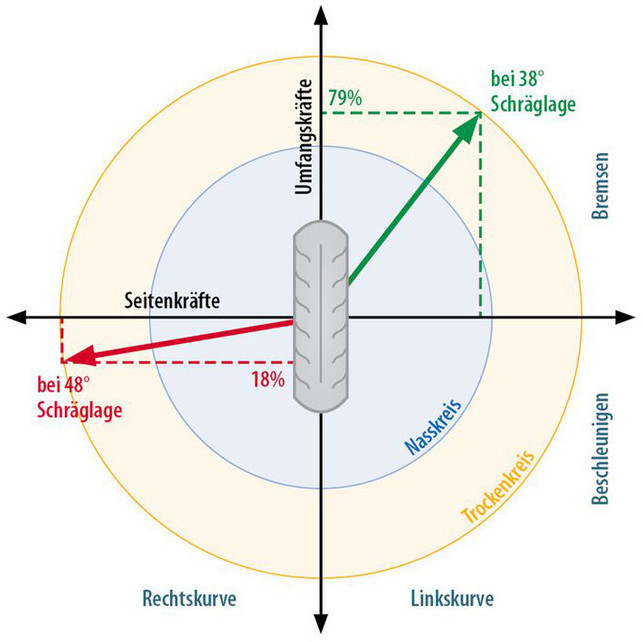
Whether on the racetrack or in road traffic — the greatest risk of falling lies in the corner. Many factors come together here that strongly influence tire grip. The Kamm circle shows these factors: longitudinal force and lateral force depend on each other — the resulting total force must not exceed the maximum friction force.
This means: the more lean angle, the less braking or acceleration force can be transferred. Anyone who understands this and works with it in a targeted way gains significantly more safety in the corner.
To make you fit for the corner
With our experience, we show you how to get through the corner safely with the right line, the optimal use of your body and the correct handling of brake and throttle.
You gain more confidence in your motorcycle, in your tires and above all in your ABILITY.
Our main focus is to reduce the lean angle of your motorcycle in order to get more tire contact area (also called contact patch). Following the motto Fly Low – Ride Safe!
Interview with Lena
The fear of lean angle is “natural” because the brain has to learn it first. Lena, today a racetrack rider, reports on her experiences.
Step 1, sit correctly. Step 2, the gaze. Step 3, build up speed.
Another video about lean angle training. Be sure to check out Jessy's progress at 05:43 min.